
Edward Snowden: 10 years on
The more things change, the more they stay the same. Here's what you can DO about it.


IMPORTANT UPDATE (December 2023):
I have come across some very disturbing information concerning some of the services recommended by as well as the person himself.
 Mr. E
Mr. E
In the meantime however, I am formally withdrawing my recommendation of Signal Messenger due to them receiving almost 3 million dollars in funding from the Open Technology Fund which is part of the global network run by the US Agency for Global Media, which is part of the US federal government.
Signal is also facing an uncertain future due to funding cuts from their ‘sponsors’.
provides the rundown in this article:
 Kit Klarenberg
Also this:
On June 6 2013, investigative journalist broke a story about how the US National Security Agency (NSA) was running a top-secret program which amongst other things, was collecting the phone records of millions of American citizens without their consent or approval and without them being convicted of any crime or even being suspected of one.
The article ended with an ominous quote from Senator Frank Church who was the chair of a committee set up by the US Congress in 1975 to investigate the activities and scope of surveillance operations by the CIA, FBI and the NSA, which since its formal creation in 1952 had a very clear stipulation in its charter to never conduct any surveillance domestically:
The NSA's capability at any time could be turned around on the American people, and no American would have any privacy left, such is the capability to monitor everything: telephone conversations, telegrams, it doesn't matter.
Senator Church’s conclusion in 1975 proved to be prophetic beyond the wildest dreams of anyone, including his own!
Two days later on June 8, Mr. Greenwald broke another story about a program called PRISM which gave the NSA direct access to the servers of Google, Apple, Microsoft and Facebook, as well as a few other unnamed tech companies.
The story included several slides from an internal NSA Powerpoint presentation which explained how PRISM operated and also revealed it has been in operation since at least 2007 (so for at least 6 years by the time the news about it became public).
All the big tech companies mentioned in the story denied any knowledge or involvement in the program despite the fact that the NSA’s own slides made it clear that while PRISM was a highly classified program, it was conducted with the full knowledge and cooperation of the tech companies involved.
Despite the prohibition in NSA’s charter to conduct any surveillance operations within US borders, the existence of PRISM was enabled by changes to US surveillance law introduced under President Bush and renewed under President Obama in December 2012.
Greenwald didn’t provide any information about how he obtained this information and the internal NSA slide deck but said that there was absolutely no doubt it is 100% authentic.
He also said that he will not give any further information about his sources (as any journalist is expected to do) other than saying it is “rock solid”.
Two days later, Greenwald’s source publicly revealed his identity as , an employee of defence contractor Booz Allen Hamilton who worked at both the CIA and the NSA as a contract analyst.
A day after Snowden publicly revealed himself as the source of the leaks, Glenn Greenwald and his colleague Ewen MacAskill blew the lid on another NSA program disclosed by Snowden and which made PRISM look like a kid’s toy in comparison.
It was called Boundless Informant.
Boundless Informant was a data mining tool which was used to catalogue surveillance data obtained through the myriad of the NSA’s surveillance programs by using the metadata contained in them.
In simple terms, it was basically an internal search engine for surveillance data obtained by the NSA.
The most explosive revelation about Boundless Informant was the scope and breadth of NSA’s surveillance programs and the almost unimaginable volume of data programs such as PRISM collected.
Just to give you an idea, the NSA’s internal documents about Boundless Informant which were leaked by Snowden showed that the agency collected 3 billion pieces of data on US citizens during March 2013 alone!
Let that sink in and then try to imagine what capabilities the NSA has 10 years later given the huge advances in computing power, AI and machine learning that have occured since.
Just over a month later Glenn blew the lid on another NSA surveillance program which eclipsed both PRISM and Boundless Informant.
It was called XKeyscore.
The NSA’s internal PowerPoint presentation on XKeyscore which was also included in Snowden’s data dump showed that, as of 2008, this tool was able to, according to their own words:
"Collect nearly everything a typical user does on the internet"
This included the content of emails, social media posts, web browsing activity and any and all metadata about the user.
This data was able to be collected in real-time on every single Internet user on the planet and NSA staff didn’t need to get any permission from anyone before sifting through this treasure trove of data which often contained highly sensitive and private information about individuals!
After Snowden came out publicly as the NSA whistleblower, things have started to move very quickly from that point onward and the rest as they say, is history…
A decade later, Ed Snowden is still stuck in Russia, a country he never intended to settle in or even enter.
The Significance of the Snowden revelations
While there have been many leaks and disclosures of nefarious activities by various US government agencies over the years prior to that point, none have even come close to the scope and significance of what has been revealed by Snowden.
A recent article by the Electronic Frontier Foundation, one of the leading global organisations dedicated to protecting people’s civil liberties online, put it best:
Snowden’s revelations acted like a flood light, allowing everyone to better see and understand what happens inside the black box of government surveillance of millions of innocent people in the US, and around the world.
The tremendous amount of evidence slowed, if not stopped, the disingenuous denials that the government had made both publicly and privately in response to our allegations.
The actual documentary evidence also helped us to better pinpoint our demands, our questions, and our legal tools.
Snowden himself also explained in a very eloquent way how such programs pose grave threat to the freedom of people globally, as well as the very integrity of the Internet, in a viral 2014 TED Talk he gave, appearing through a screen on a robot with a camera whose movement he controlled remotely.
He was unable to attend in-person due to the US government cancelling his Passport and issuing a global arrest warrant against him, stranding him in Russia to this day.
Government surveillance of the Internet has only become more pervasive since
And it's getting WORSE all the time
Many people (myself included) thought that the Snowden revelations in 2013 will mark a watershed moment and the US government, as well as other governments of the so called ‘free world’, will now be compelled to reign in their intelligence agencies by putting clear rules about what they are allowed to do (and even more importantly, what they cannot do) and then put mechanisms to ensure these rules are strictly enforced.
Unfortunately, the reality of the last 10 years is that, while some progress has been made, such surveillance programs not only didn’t disappear but have actually become much worse, especially on social media.
The Twitter Files saga this year was one of the most public culminations of that surveillance and interference by governments and their intelligence apparatus.
 Thomas Neuburger
I would also argue the intelligence apparatus in western ‘democracies’ has become an uncontrollable beast over the last decade and is now the one that is in control over the elected government, instead of the other way around.
This is what is referred to by many as the deep state. A permanent and unelected power structure sitting in the shadows and answerable to no one, least of all the people!
At this stage of the game and knowing what we know now, I’d argue that the only way to fix the predicament we are in with regards to this completely unaccountable “deep state” apparatus is to take the approach which John F. Kennedy vowed to take before he was assassinated:
“I want to shatter the CIA into 1000 pieces and scatter it to the winds!”
The same should apply to the NSA, FBI, NRO,DHS and all the other three letter agencies of the US government, as well as their counterparts in other countries.
How can you fight back against surveillance by governments and their intelligence apparatus?
Here come the SOLUTIONS
I’d argue that as things stand now, the most dangerous adversary (or “threat actor” as it is referred to in the Cybersecurity industry) for the average citizen is their own government and the last three years have proven that definitively!
The 40th US President Ronald Reagan has put it best when he said:
The nine most terrifying words in the English language are "I'm from the government, and I'm here to help."
So what can one do to protect their privacy online from snooping by governments?
Well, the answer is comprised of two main aspects:
- Encryption - making your data and activities hard to read even if intercepted; and
- Decentralisation - making your data and activities hard to intercept in the first place due to the fact it is spread across multiple servers and physical locations.
I will outline below some practical solutions, which I have been using myself for at least two years now, and which incorporate one or more of the above. All of these solutions can be accessed relatively easily by anyone and even if you are not tech savvy.
However, before I do that, allow me to touch on one other very important aspect which quite a few people I come across still don’t quite get.
Privacy matters!
Ten years after the Snowden revelations and even after the last three years of unprecedented government overreach and surveillance, I still often hear people saying something along the lines of:
“I am not really concerned about privacy because I am a law abiding citizen and have nothing to hide”.
There are two main problems with the above statement:
- Privacy is a fundamental human right formally defined as such in the Universal Declaration of Human Rights as well as article 17 of the International Covenant on Civil and Political Rights (ICCPR). This should make it very clear to any reasonable person that protecting the privacy of the individual is important, even if you yourself don’t care about it much personally. This leads me to the second problem which is…
- Allowing a human right like privacy to be breached opens the door to other basic human rights being trampled on as well. Edward Snowden put it best himself when he said the following:
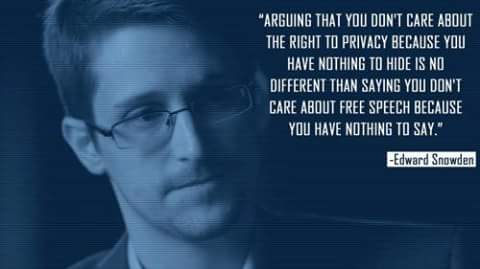
So now that you are hopefully convinced that privacy is important, let’s look at a few solutions that are available to you today.
All the solutions below offer very strong encryption and some are also decentralised which is the ultimate protection not just from governments but also from malicious hackers and cyber criminals.